Selling a home changes the way an owner looks at the property.
Rooms that have been lived in for years suddenly become projects. Walls get painted. Landscaping gets cleaned up. Flooring is considered. Fixtures are replaced. Closets are organized. Repairs that could wait another year suddenly move to the top of the list.
And behind nearly every one of those decisions is the same financial question:
“Where should I spend the money I have available so I can protect as much of the value already built into my home as possible?”
That question becomes particularly important when the condition being considered isn’t immediately visible from the living room, kitchen, or front yard.
The attic may be one of those places.
A homeowner may have lived through a previous rat problem. Someone may have trapped the animals. Entry points may have been sealed. New insulation may have been installed. Years may have passed without anyone giving the attic much thought.
But selling the property can bring that history back into focus.
A buyer’s inspector isn’t looking at the home through the same eyes as the person who has lived there. An inspection can introduce questions about conditions the seller hasn’t thought about for years — and sometimes conditions the seller never knew were there.
Before You Spend Another Dollar
Before You Spend Another Dollar on Cosmetic Improvements
What could a buyer’s inspection uncover that may cost you more?
The seller’s objective isn’t simply to make the property look better. It is to understand whether an overlooked condition could become an unexpected question, expense, or negotiating issue after the property is already on the market.
Before San Gabriel Valley Home Sellers Spend Another Dollar on Cosmetic Improvements, What Could Cost Them at Inspection?
Preparing a San Gabriel Valley home for sale can quickly become a competition for the seller’s available money.
Should you repaint? Replace flooring? Improve the landscaping? Update lighting? Change aging fixtures? Stage the property?
Each improvement may have a purpose. Presentation matters. Buyers respond to how a home looks and feels.
But cosmetic improvements and underlying property conditions are not the same financial decision.
A future owner can dislike your paint color and repaint the room. A buyer may replace flooring because they prefer another material. Landscaping can be redesigned. Fixtures can be changed.
An unexplained condition discovered during an inspection creates a different kind of conversation.
If evidence of previous or current rodent activity is discovered in an attic, the questions can multiply quickly:
- Are the rats still active?
- Where did they enter?
- Were entry points corrected?
- Are there droppings or nesting materials?
- Was insulation affected?
- Is there damage that cannot currently be seen?
- Was the attic ever cleaned?
- What work actually needs to be performed?
- How much could that work cost?
Seller Money Note
Money spent correcting a legitimate pre-existing property condition before it becomes a buyer’s negotiating point may have greater value than money spent guessing which cosmetic upgrades a future buyer will appreciate.
This doesn’t mean every attic with historical rodent evidence requires extensive remediation. It doesn’t mean every seller should remove insulation or purchase the largest cleanup package available. It means the seller should understand the condition before somebody else defines the condition for them.
Larry G. Manager — Field Note
“The procedure is visible. The reasoning is invisible.”
Removing material, cleaning an attic, or closing an opening is work a homeowner can see. The harder part is understanding why the condition exists, what changed at the property, what the animals learned about the structure, and what actually needs to be corrected.
Before the inspection, remediation is a property-maintenance decision. After the inspection, it can become a real-estate negotiation.
The useful question may not be: “How much does it cost to clean an attic?”
The better question may be: “What condition is actually present in my attic, and should I understand it before I put this property in front of a buyer?”
Can You Sell a San Gabriel Valley Home “As Is” With Evidence of Rats?
An “as-is” sale does not make the physical history of the property disappear.
A buyer may still want to understand what they are purchasing. Inspections can still reveal conditions. Questions can still be asked. A condition that was largely invisible to the seller can suddenly become very visible when someone enters the attic specifically looking for evidence of problems.
Rodent evidence can take different forms: droppings, nesting debris, disturbed or soiled insulation, odors, travel areas, openings, or penetrations that could provide access. There may be historical evidence, current activity, or conditions requiring further evaluation before anyone can responsibly determine what work is appropriate.
The point is not to frighten the seller. It is to give the seller an opportunity to understand the property while there is still time to make an informed decision.
The Seller’s Advantage
Understand the condition before it becomes somebody else’s question.
A seller who investigates a known or suspected attic condition before listing has an opportunity to understand what happened, determine what actually needs attention, complete appropriate work, and retain documentation of what was done.
Instead of beginning with: “How much is somebody going to charge me to clean this attic?”
begin with:
“What actually happened in this property, what conditions still exist, and what really needs to be corrected before I sell it?”
That question takes us into the history of the property itself.
What Has This Property Taught the Rats?
Every property has its own ecosystem, shaped by its history, pre-existing habitat, construction, repairs, utility systems, surrounding environment, and changing conditions.
When All Track Exterminators evaluates a property, one of the most useful questions is not simply: “How did the rats get in?”
It is:
“What has this property taught the rats?”
Rats interact with the property that exists in front of them.
They can learn where movement is possible, where shelter exists, where food or water may be available, which routes connect one area to another, where openings exist, and where previous human activity has altered the structure.
That is why a Property Ecosystem Inspection looks beyond a single hole.
Depending on the property, evaluation may involve visible utility penetrations, roof transitions, vegetation, wires, crawl-space openings, attic access areas, construction gaps, previous repairs, and other accessible conditions that may help explain how the property has been used.
What happened here? How has the property changed? What conditions supported the activity? What did the rats learn? Which pathways may still be available? Is the evidence historical or current? What actually needs remediation? What could change again after the work is completed?
Every property has a history. Every infestation has a story. And sometimes the property itself helped write it.
A Property Does Not Stop Changing After It Has Been Rodent-Proofed
Rodent exclusion is performed on a property as it exists at the time of the work.
But homes do not remain frozen in that condition.
Cable installers arrive. Plumbers make repairs. Electricians run lines. HVAC contractors alter equipment and penetrations. Roofers work around roof transitions. Remodelers open and close parts of structures. Homeowners add, remove, repair, and replace things.
Each alteration becomes part of the property’s evolving physical history.
That is why previous rodent-proofing should not end the investigation when new evidence appears.
The better question is: “What changed?”
Can Rats Return After a Home Has Already Been Rodent-Proofed?
Yes. Rodent-proofing can correct access conditions identified at the time of service, but a property can change afterward.
A real Pasadena property illustrates why this matters.
Previous rodent exclusion work had been performed. After the new owners took possession, they ordered cable/internet installation. Later, an area involving crawl-space screening required attention.
The lesson is not to accuse the cable installer of causing the original rodent problem.
The larger lesson is:
Larry G. Manager — Field Note
“A property does not stop changing after it has been rodent-proofed.”
A contractor may see a convenient route for a wire, pipe, duct, cable, or repair. A rat interacts with the environment that remains afterward.
For a home seller, evidence of renewed activity does not automatically prove that earlier exclusion work was meaningless or improperly performed. It may mean the property changed and needs to be understood again.
And even when the rats themselves are no longer present, another question remains:
What did they leave behind?
Removing the Rats Doesn’t Necessarily Remove What They Left Behind
The absence of movement or current animal activity does not necessarily mean the attic has been restored to its previous condition.
Rodent activity can leave droppings, nesting debris, odors, soiled materials, disturbed insulation, damaged insulation, and other post-infestation conditions that may require evaluation.
“The animal can be gone while the environmental consequences of its presence remain.”
This principle extends beyond rats.
At a Pasadena property, a skunk had been trapped and removed before the new owners received the keys.
The animal was gone.
The terrible odor was not.
The event had ended, but an environmental consequence remained inside the property.
Removing the animal and addressing what the animal left behind are not necessarily the same job.
This Is Where Hidden Biology Remediation Begins
Hidden Biology Remediation expands the question beyond: “Did we remove the rats?”
and asks: “What did their presence leave behind, and does anything remaining require attention?”
The biological consequences associated with previous animal activity do not necessarily disappear simply because the host animal is gone.
That does not mean every attic contains a hidden health hazard, and it does not justify inventing biological conditions that have not been identified.
It means animal removal is only one part of understanding the environment that remains.
Droppings, nesting debris, soiled material, odors, and affected insulation can be physical evidence of a property’s previous biological activity.
The correct response depends on what is actually present.
What If Newer Insulation Is Covering an Older Property History?
Newer insulation changes what can be seen.
At the Pasadena property, newer blown-in insulation was present in the attic.
Its presence does not prove contamination existed underneath it.
It also does not erase the history of the property.
Insulation can cover framing, attic-floor surfaces, travel areas, penetrations, and other parts of the structure that may become more visible when material is removed as part of an appropriate scope of work.
“The property has a history, even when parts of that history are no longer visible.”
This is why an attic cleanout should not be treated merely as a race to remove material.
The work should have a reason.
What Happens During a Professional Rodent Attic Cleanout?
A professional rodent attic cleanout should begin with understanding why material is being removed and what conditions the work is intended to address.
Depending on the property and agreed scope, work may involve removal of blown-in insulation or affected materials, accessible droppings, nesting debris, and other material associated with rodent activity.
But the work also has to account for something below the attic: the occupied home.
How Do You Clean a Rodent Attic Without Bringing the Attic Through the House?
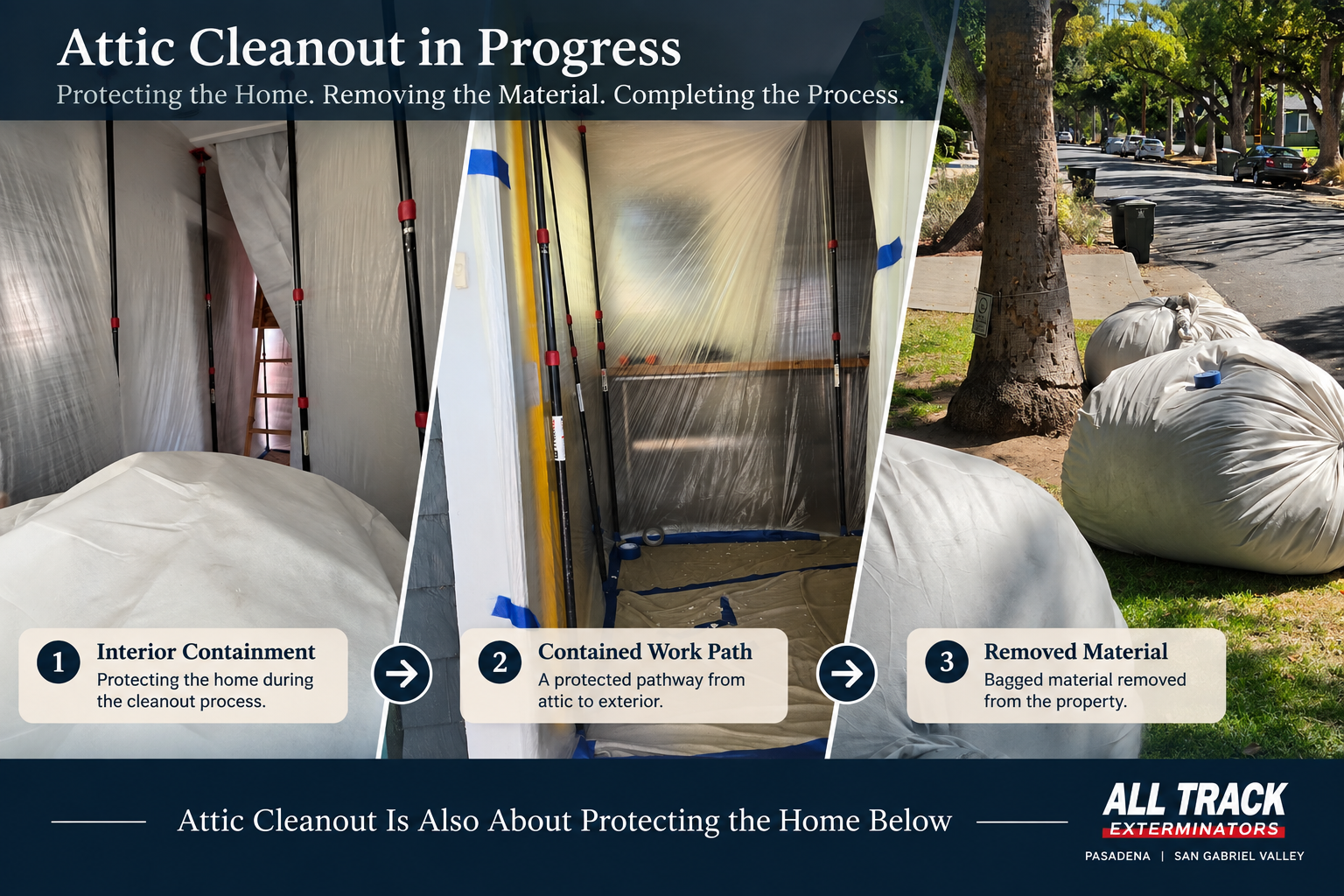
At the Pasadena property, attic access was through a pull-down staircase located inside the home.
That meant the work path itself had to be considered.
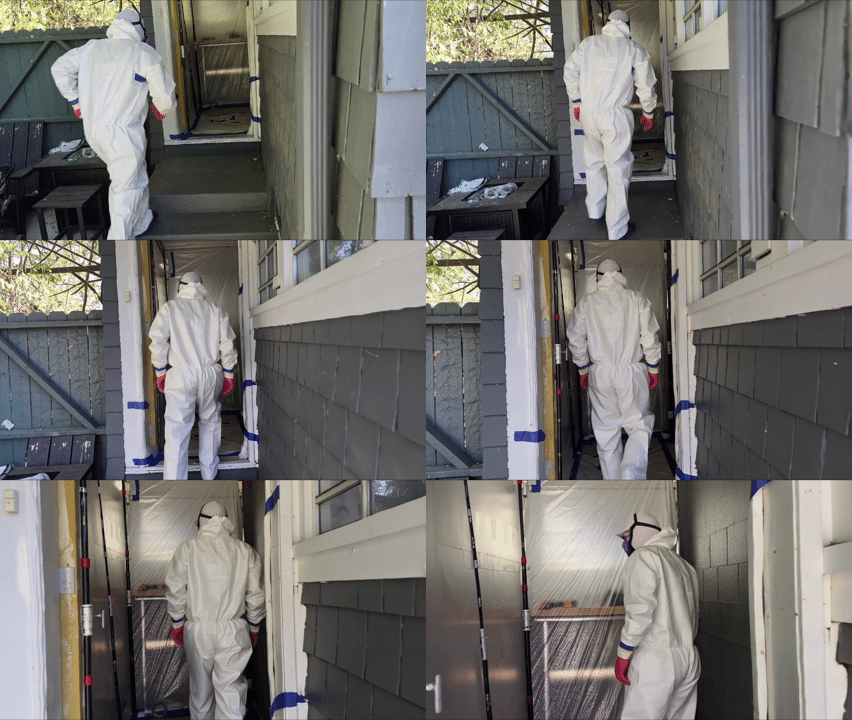
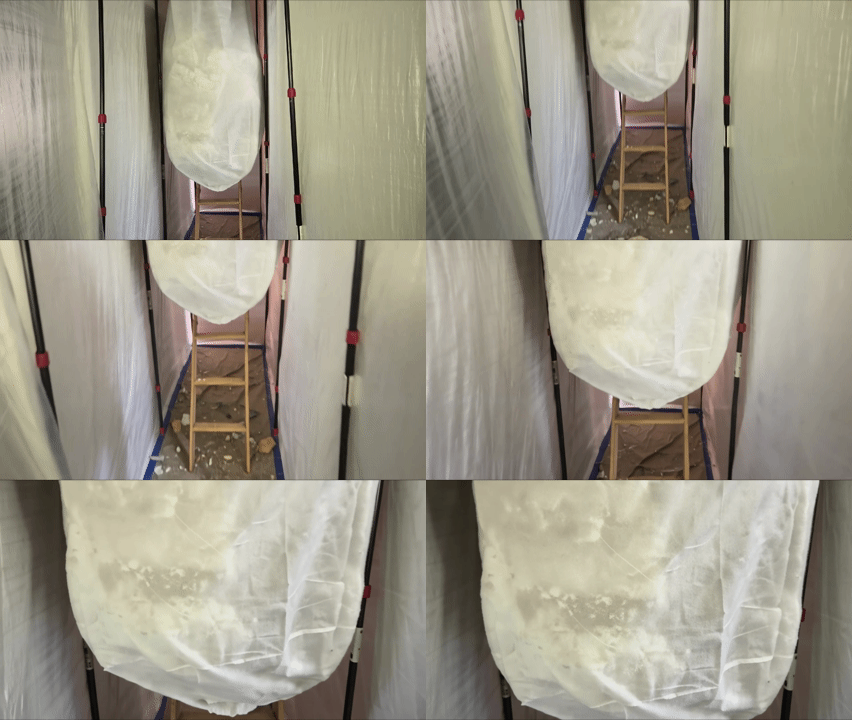
All Track Exterminators established an interior containment barrier/tunnel around the attic access and work path to help isolate the work area from the occupied portion of the home during the cleanout process.
Attic Cleanout Is Also About Protecting the Home Below
A homeowner may naturally focus on what is being removed from the attic.
The work team also has to think about how that material travels out of the work area.
Containment, access planning, movement of removed material, and protection of occupied areas are part of the physical procedure.
Larry G. Manager — Field Note
“The procedure is visible. The reasoning is invisible.”
A photograph can show containment. A photograph can show material being removed. A photograph can show the attic after cleanout.
But the photograph cannot by itself explain why the work was necessary, what the property taught the rats, what changed over time, or why one scope may be more appropriate than another.
That reasoning is part of the service too.
What Can an Attic Reveal After the Blown-In Insulation Is Removed?
When an appropriate scope includes removal of blown-in insulation, the visual relationship with the attic changes.
Areas that were obscured may become accessible for further observation.
Depending on construction and actual conditions, this can include framing, attic-floor surfaces, utility penetrations, openings, structural transitions, and other accessible areas.
Removal does not magically tell the entire history of the property.
It can, however, make portions of that history easier to examine.
A Clean Attic Can Make the Property Easier to Understand
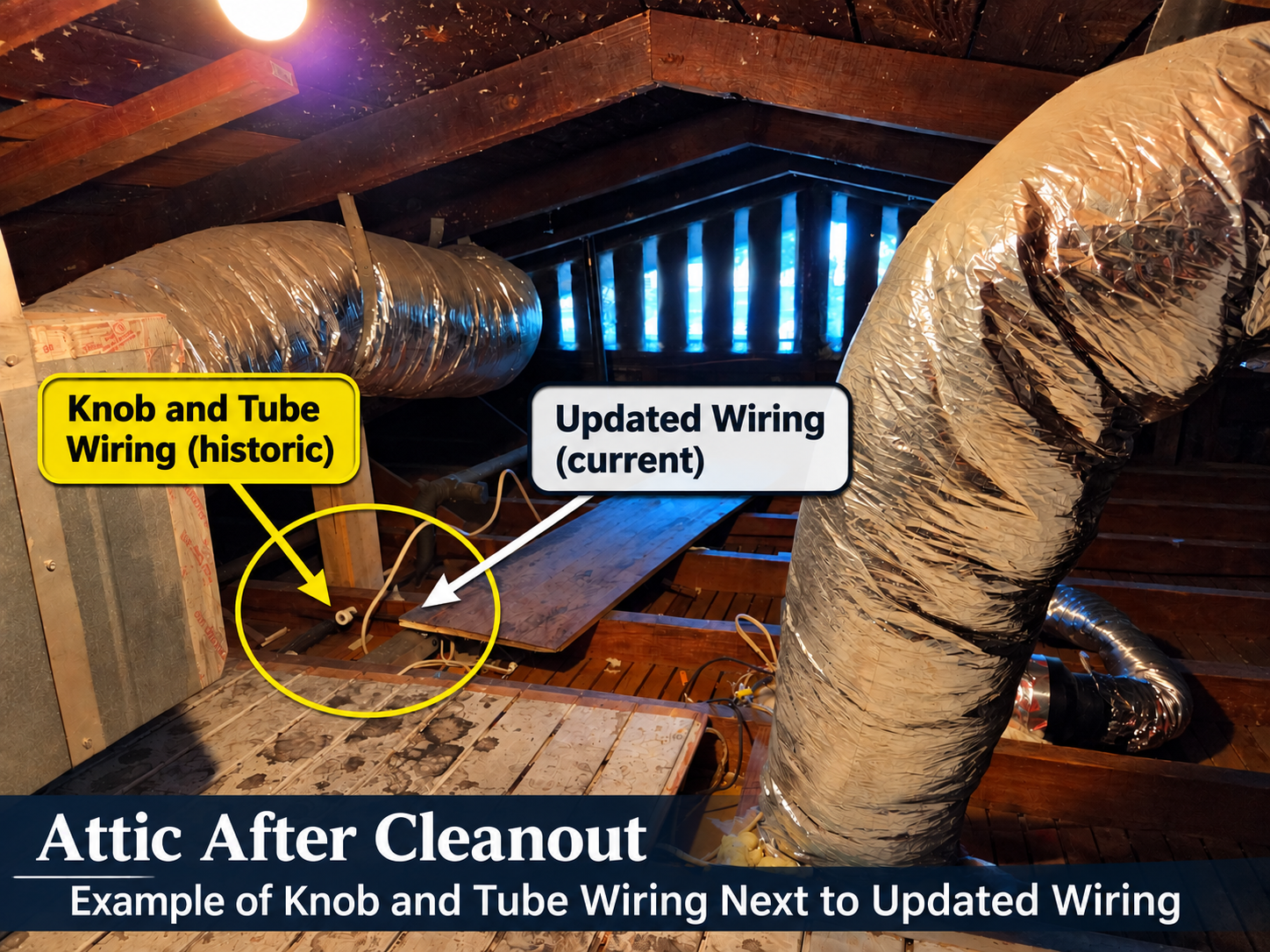
The after-cleanout photographs from the Pasadena property document the attic after blown-in insulation/material had been removed.
They do not document original pre-cleanout contamination because those photographs were not taken.
That distinction matters.
The objective is not to manufacture a dramatic before-and-after story.
The objective is to create an accurate property record.
Photo Group — After Cleanout · Post-Cleanout Attic Condition
What Should Be Examined After an Attic Cleanout?
Once previously covered areas are visible, the investigation can return to the property itself.
What accessible framing can now be observed? What penetrations are visible? Are there openings or transitions requiring attention? Are there areas consistent with travel? Do visible conditions help explain the property’s history? Does anything require additional evaluation?
And again: “What has this property taught the rats?”
“Is there anything here that should be addressed before a buyer’s inspector is the person asking these questions?”
Does Every Attic With Evidence of Rats Need Complete Insulation Removal?
No.
Evidence of rats does not automatically establish that every piece of attic insulation must be removed.
The appropriate scope should follow actual conditions.
Consider what evidence is present, where it is located, what materials appear affected, what can reasonably be cleaned or removed, what access conditions exist, and what the agreed remediation objective is.
The objective should not be: “How much work can we sell this homeowner?”
It should be:
“What work does this property actually need?”
How Much Can Rodent Attic Remediation Cost Before Selling a Home?
Rodent-related attic work can range from focused corrective service to a much larger project involving exclusion, removal of affected material or insulation, cleanup, sanitation, and restoration.
Cost depends on the actual property, conditions, accessibility, materials, scope, and provider.
In more extensive situations, homeowners may encounter remediation proposals reaching $15,000–$30,000, depending on conditions and recommended scope.
Important Price Note
That figure is not an All Track Exterminators price quote.
It represents the kind of substantial remediation proposal a homeowner may encounter when extensive work is recommended. The size of a proposal should not replace understanding what the property actually needs.
A $20,000 Proposal and a $20,000 Property Problem Are Not Necessarily the Same Thing
A contractor’s proposal represents the scope that contractor is recommending.
Finding rodent evidence does not automatically establish that every possible procedure is required.
What conditions were actually found? Which materials are affected? What access points were identified? What is being removed? What is being cleaned? What is being corrected? What is being restored? What protection is included afterward?
Only then can the seller evaluate whether the proposed scope makes sense for the property.
Protect the Money You’re Preparing to Put Into the Sale
There may be only so much money available before listing.
That money could go toward paint, flooring, landscaping, fixtures, staging, repairs — or correcting an underlying property condition that could otherwise become part of an inspection conversation.
Seller Money Note
“Where should I spend the money I have available so I can protect as much of the value already built into my home as possible?”
The Seller Is Not Trying to Buy the Biggest Remediation Package
The objective is to identify the legitimate condition, understand what requires correction, complete appropriate work, and document the result.
The financial proposition is not: Spend $20,000 trying to add $20,000 of cosmetic value.
The more useful objective may be:
“Prevent a correctable property condition from becoming a $20,000 negotiating problem.”
No remediation can guarantee a sale price, return on investment, or negotiation outcome.
But understanding and addressing a legitimate condition before the transaction becomes pressured can give the seller more control over the decision.
How Does a Home Seller Prove the Rodent Problem Was Addressed?
Cleaning an attic and being able to explain what was done are two different things.
Documentation can help move the property’s story from an unexplained condition toward a record of evaluation and completed work.
Depending on services actually performed, documentation may include areas evaluated, identified conditions, corrective/exclusion work, cleanout information, photographs, completed service records, and applicable written warranty/service information.
“A clean attic is visible. Documentation helps explain how it got that way.”
Condition → Evaluation → Corrective Work → Completed Result
From an Inspection Question to a Completed Answer
Compare: “What is this going to cost us?”
with a condition already evaluated, identified work completed, visible completed attic condition, and documentation explaining what was done.
The buyer can still ask questions. The seller cannot control every inspection, buyer, or negotiation.
But an unexplained condition and documented completed work do not tell the same property story.
This Is Where the Clean Attic Becomes More Than a Cleanup
The seller began with money.
Then came the attic. Then the property’s history. Then: “What has this property taught the rats?” Then property changes. Then what the animals left behind. Then cleanup. Then newly visible areas. Then evaluation. Then documentation.
The visible result becomes connected to the reasoning behind it.
Clean Attic. That’s Peace of Home.
Is a Lifetime Rodent Warranty Better?
A lifetime warranty sounds reassuring.
But before using warranty length as the primary comparison, ask:
“What exactly is being warranted — and what caused the rodents to use this property in the first place?”
A warranty can be valuable according to its actual written terms.
But warranty length alone does not explain why rodents entered, how they traveled, what conditions supported activity, what they left behind, whether the attic required remediation, or how the property may change after the work.
A Warranty Cannot Replace Understanding the Property
A warranty cannot prevent every future contractor from altering a structure.
It cannot freeze a home in time.
And warranty language alone does not tell the homeowner whether droppings, nesting material, odors, affected insulation, or other post-infestation conditions require attention.
Warranty Length and Property Understanding Are Two Different Things
What happened? What is current? What changed? What has this property taught the rats? What needs correction? What should be remediated? What should be documented?
Only after those questions does protection behind completed work become meaningful.
Why Defined Transferable Protection Can Matter During a Home Sale
When written service terms include transferable protection, that protection can help clarify what stands behind completed work during a property handoff. The value is in the actual written coverage, conditions and scope—not simply the length of the warranty.
Don’t Just Choose the Lifetime Warranty Sticker. Understand What Stands Behind It.
The strongest protection is not simply the largest number printed beside “Warranty.”
It is understanding the property, correcting identified conditions, completing appropriate remediation, documenting the work, and knowing exactly what protection stands behind the service.
“A warranty cannot replace understanding the property.”
The warranty isn’t the product.
It stands behind the work.
The Pre-Sale Rodent Remediation Gold Standard
The seller’s question has changed.
It is no longer simply: “Do I need pest control?”
It becomes:
“What condition do I want this part of my property to be in when I hand the keys to the next owner?”
Understand the Property Before Prescribing the Work
Separate historical evidence from current conditions where possible. Look for accessible entry conditions. Consider how the property changed. Ask what previous repairs/services occurred. Ask: “What has this property taught the rats?”
Correct the Identified Conditions
When legitimate access or property conditions are identified within the service scope, address them appropriately.
Remediate the Attic Appropriately
Cleanup should follow actual conditions. Depending on property and agreed scope, this may involve affected materials, accessible droppings, nesting debris, insulation, sanitation, or other appropriate work.
Understand why. Perform appropriate work. Leave a result that can be explained.
Document the Completed Work
Photographs and service documentation can create a record of what was evaluated and completed.
No manufactured before-and-after story. No claims beyond the evidence.
Provide Defined Protection During the Property Handoff
When applicable under written service terms, defined transferable protection can accompany completed work during the transition between owners.
“The warranty isn’t the product. It stands behind the work.”
Don’t Sell the Buyer a Rodent Problem. Sell Them the Solution.
A seller cannot control every buyer question, inspection finding, or negotiation.
But a seller can decide whether a known condition remains ignored or is investigated and appropriately addressed.
Desired progression:
Investigated. Corrected where appropriate. Remediated. Cleaned. Documented. Protected under applicable written service terms.
That is the Pre-Sale Rodent Remediation Gold Standard All Track Exterminators is working toward.
Clean Attic. That’s Peace of Home.
Not because a clean attic guarantees the sale. Not because remediation guarantees a selling price.
But because the seller has taken an overlooked part of the property and moved it from an unanswered question toward completed, explainable work.
“Protect the value already built into the home before an overlooked condition becomes part of the buyer’s negotiation.”
If You Would Address a Past Roof Leak Before Selling, What About a Past Rodent Infestation?
Home sellers already understand that a property has a history.
A roof may have leaked. A plumbing line may have failed. A room may have flooded.
When water has entered a structure, concern is not always limited to whether the leak was repaired. A homeowner may also want to know what happened to materials exposed to moisture and whether additional conditions developed afterward.
Rodent activity deserves the same kind of thoughtful question.
If rats previously occupied an attic, trapping the animals or stopping activity answers only one part of the property’s history.
What happened to the attic after the rats were gone?
Were droppings removed? Was nesting debris present? Was insulation soiled? Were affected materials cleaned or removed? Were entry conditions identified and corrected? Was the attic sanitized when appropriate? Was completed work documented?
That is where Hidden Biology Remediation adds another dimension to the seller’s thinking.
A roof leak makes us think beyond the hole in the roof. A plumbing leak makes us think beyond the broken pipe.
“Why should a rodent infestation make us think only about the rat?”
The animal is only one part of what happened to the property.
“If I know this property previously had rodent activity, can I explain what was done about it?”
“I had somebody trap the rats” tells only part of the story.
Compare that with:
“The rodent activity was evaluated. The identified access conditions were addressed. The affected attic was remediated and cleaned. The work was documented.”
That is a different property story.
Don’t Wait for the Disclosure Process to Make You Think About the Attic
A California home sale involves seller disclosures and can involve buyer inspections and questions concerning property condition.
A prior rodent infestation does not automatically create a specific legal disclosure requirement in every case. Sellers who know of previous rodent activity should discuss their actual disclosure obligations with their real-estate professional or other qualified adviser.
Separately is the practical property question:
“Was the animal removed, or was the condition it left behind addressed too?”
Clean Attic. That’s Peace of Home.
“Clean Attic” is not merely cosmetic cleanliness. It represents a seller being able to say: I investigated the condition. I understood what needed attention. Appropriate work was completed. I have a record of what was done.
Questions San Gabriel Valley Home Sellers Ask About Rodent Activity Before Selling
Should I have my attic inspected for rats before listing my home?
If you know or suspect that rats have previously used the attic, evaluating the condition before listing can give you more time to understand what happened and determine whether corrective work is appropriate. Waiting until a buyer’s inspection may introduce those same questions while the property is already under negotiation.
Can I sell my house “as is” if there has been rodent activity?
An “as-is” sale does not necessarily prevent a buyer from conducting inspections or asking questions about conditions discovered at the property. If you know there has been previous rodent activity, discuss any disclosure obligations with your real-estate professional and consider whether the underlying property condition should be evaluated before listing.
Can rat activity affect the sale of a home?
Potentially. Questions can arise about current activity, entry points, droppings, nesting debris, affected insulation, cleanup, damage, and what remediation may still be necessary.
If the rats are gone, do I still need to clean the attic?
Not every previous rodent problem requires the same cleanup. The important question is what the activity left behind. Droppings, nesting debris, soiled materials, odors, or affected insulation may remain and should be evaluated according to actual conditions.
Does all attic insulation need to be replaced after rats?
No. Evidence of rats does not automatically establish that all attic insulation must be removed or replaced. Scope should be based on location and extent of conditions discovered and work actually required.
Can rats return after a home has already been rodent-proofed?
Yes. A property can change after exclusion work. Cable installation, plumbing, HVAC, electrical work, roofing, remodeling, and other alterations can affect previously protected areas or create new openings.
What should I do if a home inspector finds rat droppings in the attic?
First determine what the evidence represents rather than immediately assuming the largest possible remediation is necessary. Consider whether evidence appears historical or current, what materials are affected, whether access conditions remain, and what corrective work is appropriate.
How do I show a buyer that rodent remediation was completed?
Keep documentation associated with the work. Depending on services performed, this may include inspection findings, service records, photographs, completed exclusion/cleanout information, and applicable written warranty information.
Is a lifetime rodent warranty better when I’m selling my home?
Warranty length is only one consideration. A warranty does not by itself explain why rodents entered, what conditions they left behind, whether the attic was appropriately remediated, or how the property might change after the work.
Don’t just choose the Lifetime Warranty Sticker. Understand what stands behind it.
How much can rodent attic remediation cost before selling a home?
Costs can vary substantially according to conditions found and scope proposed. Extensive projects involving exclusion, insulation removal, cleanup, sanitation, and restoration can produce significant proposals. A seller should understand what the property actually needs before deciding on scope.
Should I spend money remodeling before dealing with a rodent attic problem?
They solve different problems. Cosmetic improvements may improve presentation, while an unresolved rodent-related condition may create questions during inspection. Sellers with limited pre-sale funds may benefit from evaluating known property conditions before deciding how much to commit to cosmetic improvements.
If I previously had rats trapped, should I think about that before selling?
Yes. Trapping addresses the animals, but it does not necessarily tell you what conditions remain or whether entry points, droppings, nesting debris, soiled materials, or other consequences were addressed.
A useful question: “Was the animal removed, or was the condition it left behind addressed too?”
Preparing to Sell a San Gabriel Valley Home?
Have the attic evaluated before a buyer’s inspection makes the decision for you.
All Track Exterminators can evaluate visible rodent-related attic conditions, identify areas requiring further attention, and help determine whether attic cleanup, exclusion, or remediation should be considered before the property changes hands.
The objective is not to sell the homeowner the largest possible project.
It is to understand the property, identify legitimate conditions, and determine an appropriate next step.
Protect the value already built into your home before an overlooked attic condition becomes part of the buyer’s negotiation.
All Track Exterminators — Pasadena, California
Clean Attic. That’s Peace of Home.


