San Gabriel Valley Home Seller • Realtor • Home Buyer Guide
Exterminators Pre-Sale Attic Inspection and Cleanout for San Gabriel Valley Home Sellers: What to Check Before Staging
A Value Conservation conversation for Realtors and home sellers: before the pre-sale budget goes to paint, flooring, landscaping and staging, what should be understood about the complete property being handed to the next owner?
Field perspective by Larry G. Manager — All Track Exterminators
Fresh paint can change the way a room feels. Resurfaced cabinets can make an older kitchen look more current. New flooring can brighten the interior. Landscaping can improve curb appeal. Professional cleaning and staging can help a buyer imagine living in the home.
For a seller preparing a San Gabriel Valley property for market, those improvements can lead to an important financial question:
Where should I spend the money I have available so I can protect as much of the value already built into my home as possible?
That question may deserve to be asked before the entire preparation budget is committed to what buyers can see.
Because a buyer is not purchasing only the rooms in the listing photographs. The buyer is purchasing the property behind, below and above those rooms too.
Before spending thousands of dollars making the property look ready for its next owner, has anyone asked about the condition of the complete property being handed over?
That includes one area a buyer may never see during a showing: the attic.What are you completely handing over—and what would the next homeowner rather receive?
Staging Prepares a Home to Be Seen. What Prepares It to Be Examined?
Short answer: Pre-sale preparation can include more than appearance. Understanding known or suspected attic conditions before listing may give a seller more time to evaluate legitimate problems, choose an appropriate scope of work and document what was done before those conditions become part of a buyer’s inspection and negotiation.
A seller’s preparation budget can disappear quickly: painting, flooring, landscaping, repairs, deep cleaning, windows, decluttering, furniture and staging.
Most of those expenses improve what people can see. But a beautifully painted ceiling tells a buyer very little about what is sitting above it.
What condition is the property actually in beyond what the buyer can see?
Three People Can Look at the Same Attic for Three Different Reasons
For the Home Seller
What am I completely handing over? Understand known attic history, visible conditions and whether evaluation or cleanup should be considered before listing.
For the Realtor
What should be raised before staging? A Realtor does not need to diagnose rodent activity. Recognizing when attic history deserves specialist evaluation can start the right conversation earlier.
For the Home Buyer
What am I completely buying? The condition above the ceiling can be part of understanding the complete property—not simply the finishes presented during a showing.
Before Value Addition, Should There Be a Value Conservation Conversation?
There is room in the pre-sale process for two different conversations.
Value AdditionWhat can we improve to make this property more attractive, current or market-ready?
Value ConservationWhat existing property conditions should we understand or appropriately address before spending heavily on appearance?
These ideas do not compete with one another. They belong in a thoughtful sequence.
A seller may have a limited amount of money available before listing. Money spent correcting a legitimate pre-existing property condition before it becomes a buyer’s negotiating point can serve a very different purpose from money spent guessing which cosmetic improvement a future buyer will appreciate most.
This is not a promise that an attic service will increase a home’s sale price. It is a reason to understand the property before allocating the entire pre-sale budget to appearance.
We Ask About Water and Previous Repairs. What About the Attic’s History?
Property history matters. Sellers and real-estate professionals may already discuss known leaks, water intrusion, previous repairs and other conditions relevant to the property.
So consider another set of questions:
Has wildlife ever entered the attic?Have rats or mice ever been present?If rodents were removed, what happened to the attic afterward?Was affected material cleaned or removed?Was exclusion work performed?Has cable, HVAC, electrical, plumbing, roofing or remodeling work changed the property since then?Is old insulation obscuring portions of the attic that have not been viewed in years?
The first time a seller seriously thinks about a past rodent or wildlife condition should not have to be when a buyer’s inspector photographs evidence of it.
A Realtor does not need to diagnose a rodent condition or determine the technical scope of remediation. Starting the conversation simply creates an opportunity for an appropriate specialist to evaluate the condition when needed.
“We Got Rid of the Rats” Does Not Answer Every Question
Imagine rodents entered an attic several years ago. Someone trapped them. Activity stopped. The homeowner moved on.
That tells us something important. It does not necessarily tell us the condition of the attic today.
Were droppings or nesting materials left behind? Was affected insulation addressed? Were entry conditions identified? Was exclusion performed? Has later work altered a previously secured area?
This is where All Track Exterminators uses a different field question:
What Has This Property Taught the Rats?
Every property has its own ecosystem, shaped by its history, pre-existing habitat and changing environmental conditions.
Rodents interact with that environment. They can learn where entry is possible, where travel is protected, where food or water is available, where nesting is possible and where they can remain difficult to detect.
And the property itself keeps changing. A home that was rodent-proofed years ago is not frozen in time. Later cable, HVAC, electrical, plumbing, roofing or remodeling work can alter parts of the structure. Vegetation changes. Materials age. Conditions around neighboring properties change.
A property does not stop changing after it has been rodent-proofed.
Property Ecosystem Inspection: What Has This Property Taught the Rats?
Every property has its own ecosystem, shaped by its history, pre-existing habitat and changing environmental conditions. An attic cannot always be understood by looking only at the attic floor. The landscape and exterior environment can help explain how rodent pressure reaches the structure.
Landscape Bridges
Tree limbs, palms, vines, ivy and dense vegetation near rooflines.
Property Change
Cable, HVAC, electrical, plumbing, roofing and remodeling work can alter previously secured areas.
Environmental Pressure
Food, water, shelter, neighboring properties and protected travel routes can influence activity.
The inspection question is not only “Where is the hole?” It is also: “What conditions around this property made the structure useful to the animal?”
The Animal Can Be Gone While Conditions It Left Behind Remain
Removing an animal and addressing the conditions associated with its previous presence are not necessarily the same job.
Past animal activity can leave droppings, nesting material, odors, affected insulation or other conditions that warrant evaluation. The appropriate response depends on what is actually found.
At All Track Exterminators, this broader line of reasoning is part of what we call Hidden Biology Remediation: looking beyond the question “Did we remove the rats?” and asking, “What did their presence leave behind, and does anything remaining require attention?”
Not every attic needs complete remediation. Not every old sign means rodents are currently active. Not every attic requires insulation removal.
Don’t assume. Evaluate.
Before the Inspection, the Seller Still Has Choices
Timing changes the context of a property condition.
Before a buyer’s inspection identifies a legitimate attic problem, the homeowner may be able to investigate it as part of ordinary property preparation. Once a condition appears in an inspection, it can become part of a transaction discussion involving additional evaluation, repair requests, estimates, negotiations or credits, depending on the findings and the terms of the transaction.
Before the inspection, remediation is a property-maintenance decision. After the inspection, it can become a real-estate negotiation.
Now consider a home where there is no known active rodent problem.
The seller may already be paying for a deep cleaning. Old belongings are removed. Carpets are cleaned. Windows are washed. Kitchen surfaces are prepared. The garage is organized. Landscaping is refreshed.
The home is being prepared for a new owner.
Why should that preparation automatically stop at the ceiling?
An attic can contain years of accumulated dust, discarded materials, roofing debris from previous work, deteriorated or uneven insulation, or evidence of previous animal activity.
A New Start for the Next Owner.
The living spaces aren’t the only parts of a home that change hands.
Pre-Moveout Attic Cleanout — A New Start for the Next Owner
What is a Pre-Moveout Attic Cleanout? It is the idea of evaluating and, when appropriate, preparing the attic as part of a more complete property handoff before the seller moves out. The actual scope can vary by attic and may include material removal, cleaning, sanitation when warranted, exclusion or remediation when needed, and insulation work when selected and appropriate.
This does not have to begin with an infestation.
It begins with a simple observation: the living room changes hands. The kitchen changes hands. The bedrooms change hands. The garage changes hands.
The attic changes hands too.
Don’t Just Cover the History of the Attic With New Insulation
Sometimes the next step after attic material removal is new insulation. But the value of the process is not simply putting new material where old material used to be.
Removal can also create visibility.
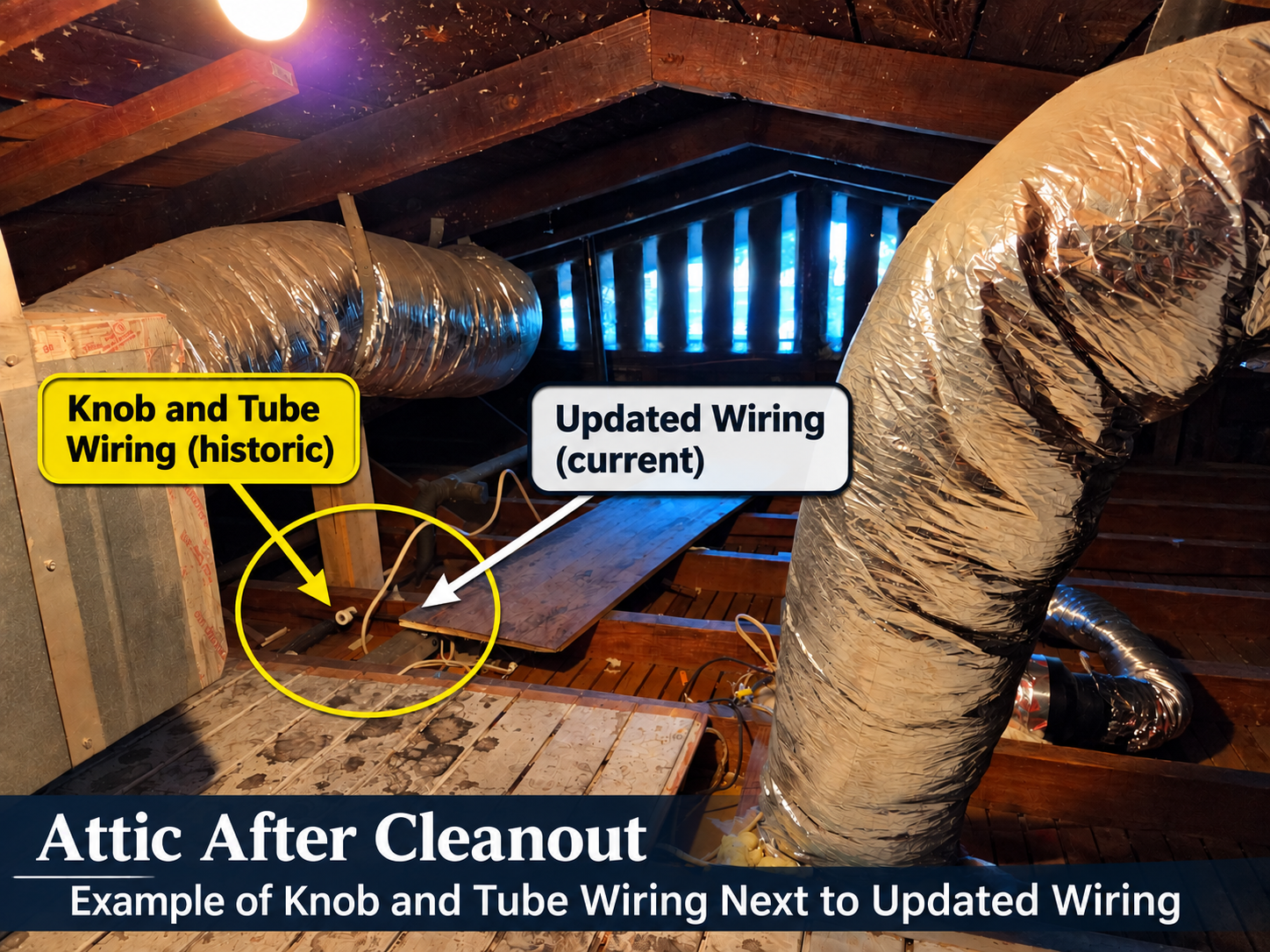
Larry G. Field NoteDuring an actual Pasadena attic cleanout performed by All Track Exterminators, removal of blown-in material made previously obscured portions of the attic easier to view. Historic knob-and-tube wiring could be seen alongside updated electrical wiring. That observation was not an electrical inspection or a determination of electrical safety. It demonstrated something more basic: removing attic material can expose property conditions that were previously difficult to see.
The property has a history, even when parts of that history are no longer visible.
Old insulation can obscure portions of that history. So can accumulated debris and previous work.
When removal is warranted, preparing the attic before replacement insulation goes in creates a different starting point from simply covering everything with another layer.
After attic material was removed, previously obscured property conditions could be viewed more clearly, including historic knob and tube wiring alongside updated wiring.
Can New Attic Insulation Improve Heating and Cooling Performance?
Yes, when the existing condition is deficient and the new attic system is properly designed and installed. Insulation resists heat flow, and its performance depends on factors including R-value, depth, even distribution, installation quality, air sealing and the condition of the existing assembly. Replacing inadequate or compromised insulation with an appropriately specified system can improve thermal performance compared with the deficient condition.
This is why the attic should be treated as a system rather than simply a place to blow in more material.
ENERGY STAR recommends evaluating insulation levels and air sealing the attic before adding insulation. Its guidance also notes that old insulation does not automatically need removal; removal becomes more relevant when existing material is wet, moldy, smelly or contains animal waste. That distinction supports the same inspection-first principle: the condition should determine the work.
Evaluate → Remove What Should Not Remain → Expose the Attic → Address Appropriate Conditions → Clean or Sanitize When Required → Air-Seal / Prepare as Applicable → Install the Selected Insulation System
New insulation performs best when the attic and building assembly underneath it have been appropriately prepared for the installation.
Complete Home Handoff — From Attic to Living Space
Now the seller’s question changes. Instead of asking only:
How do we make this house look newer?
the seller can also ask:
How completely do we want to prepare this home for its next owner?
That preparation may include paint, updated surfaces, landscaping, deep cleaning and professional staging. And, when the condition and budget support it, it can include an evaluated and prepared attic.
This is not about assigning a dollar-for-dollar increase in market value to attic cleaning. It is about understanding and preparing more of the property being transferred.
Staging prepares the property to be seen.Value Conservation prepares the seller to think about what may be examined.Complete Home Handoff asks whether preparation should extend from attic to living space.
Now Put the Seller on the Other Side of the Transaction
The seller handing over the keys today may soon be the buyer receiving someone else’s keys.
Imagine that you cleaned your current home, prepared the living spaces, evaluated the attic and addressed the conditions you decided should not be handed to the next owner.
Now you are standing in your next home. Would you want the previous owner to have given you that same consideration?
If a clean, evaluated attic matters when you’re handing over your home, why wouldn’t it matter when you’re receiving someone else’s?
Two Questions at the Property Handoff
The SellerWhat am I completely handing over?
The BuyerWhat am I completely buying?
Those questions are larger than pest control. They are questions about understanding the property itself.
Before Staging Your San Gabriel Valley Home, Start With the Complete Property
A seller does not need to assume something is wrong with the attic. A Realtor does not need to become a pest-control expert. And an older attic does not automatically need an expensive cleanout.
The opportunity is simpler:
Ask the question before the transaction asks it for you.
What is the history of the attic? What is its present condition? Has wildlife or rodent activity occurred? What work has happened since? What materials remain? Does anything legitimately require attention?
And if the seller is already preparing the property for its next owner: Should that preparation stop at the ceiling?
Questions Realtors, Sellers and Buyers Can Ask
Should every seller automatically clean out the attic before listing?
No. Start by understanding the condition. The appropriate response may range from no attic work to targeted cleanup, rodent exclusion, sanitation, insulation work or further specialist evaluation.
Does a Realtor need to inspect for rodents?
No. The useful role is recognizing relevant property history or visible concerns and encouraging appropriate specialist evaluation when warranted.
Does rodent removal mean the attic is clean?
Not necessarily. Removal addresses the animal. The attic’s condition depends on what activity occurred, what materials were affected, what cleanup was performed and whether entry conditions were addressed.
Can a property change after rodent-proofing?
Yes. Later cable, HVAC, electrical, plumbing, roofing or remodeling work can alter parts of a structure. That is one reason a current property evaluation can matter even when exclusion work was performed in the past.
Preparing a San Gabriel Valley Home for Its Next Owner?
All Track Exterminators can evaluate visible rodent-related attic conditions and help determine whether cleanup, exclusion or remediation should be considered before the property changes hands. Where broader attic cleanout or insulation work is being considered, the condition of the attic should guide the scope.
Call (626) 344-2464Read the Pasadena Seller Pillar Guide
All Track Exterminators — Pasadena and the San Gabriel Valley
Before you spend the entire pre-sale budget making the home look ready for its next owner, consider whether the complete property is ready to be handed over.
From attic to living space.
Clean Attic. That’s Peace of Home.
Exterminators Pre-Sale Attic Inspection and Cleanout for San Gabriel Valley Home Sellers: What to Check Before Staging September 17th, 2026[email protected]