

Homeowners across the San Gabriel Valley are beginning to notice something that doesn’t feel like coincidence anymore.
Reports of scratching in attics, droppings in garages, and late-night movement inside walls are becoming more frequent, especially in neighborhoods closest to the foothills.
What many are experiencing is not isolated.
It is part of a growing pattern—what can only be described as a rodent surge in Arcadia foothill homes—and it is being driven by a combination of environmental conditions unique to this area.
Arcadia Foothill Property Ecosystem Inspection
Rodent activity often starts outside your home before moving inside. Get a full property inspection to identify food sources, entry points, and environmental conditions attracting rodents.
Arcadia is not just another suburban city.
It sits along the base of the San Gabriel Mountains and is deeply connected to surrounding wildlife corridors. Homes here are not isolated from nature—they are part of it.
This proximity creates a dynamic environment where animals, insects, and seasonal changes all intersect with residential living.
When conditions shift, those changes are often felt first in foothill communities, and right now, those shifts are favoring rodents.
The Specialist Advantage: Landscape Audit
When and why do pests attack your structure?
As Property Environment Specialists, we identify the Landscape Bridges—overgrown ivy, unclipped limbs, and dense vegetation—that allow wildlife to reach your home. By auditing your property, we stop the opportunity for a break-in before it happens.
Establish your ‘Natural Zone’ today. Professional environmental action is the key to permanent exclusion.
The increase in rodent activity is not random.
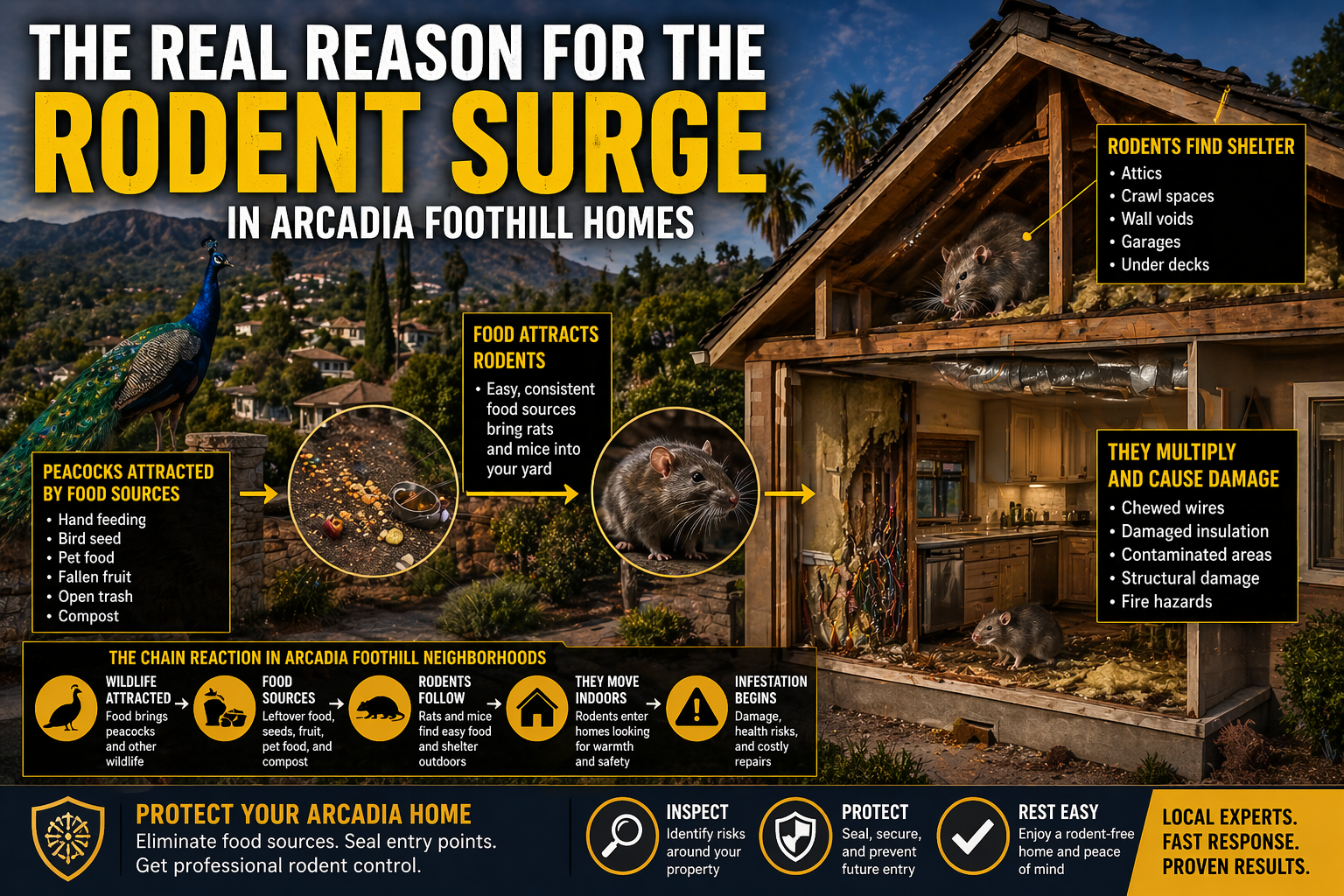
It is the result of a chain reaction that begins outside the home and gradually works its way in. To understand why this is happening, it is important to look beyond the symptoms and examine the conditions that are attracting rodents into these neighborhoods in the first place.
One of the most overlooked factors contributing to this surge is something that many Arcadia residents are already familiar with—the presence of wild peafowl, commonly referred to as peacocks.
Arcadia is well known for its population of these birds, which have lived in the area for generations after being introduced in the late 19th century and spreading into surrounding neighborhoods .
While they are often admired for their appearance and considered part of the city’s character, their presence has created an unintended ecological side effect that most homeowners don’t immediately recognize.
Protect Your Arcadia Home from Rodent Entry
Rodents entering foothill homes often exploit rooflines, attic vents, and structural gaps. Identifying and sealing these access points is critical to stopping recurring infestations.
Peafowl are omnivorous and opportunistic feeders, consuming seeds, plants, insects, and small animals in their environment .
However, in residential settings, their behavior changes. When residents feed them—or when pet food, birdseed, compost, or fallen fruit is left accessible—these food sources begin to accumulate in predictable locations. Over time, these same locations become reliable feeding zones not just for peacocks, but for other wildlife as well.
This is where the connection to rodents becomes critical.
Rodents do not move randomly. They follow food, shelter, and safety. When a consistent food source is introduced into a neighborhood—whether intentional or not—rodent populations respond quickly.
The same conditions that attract peafowl, such as exposed food, dense landscaping, and quiet residential spaces, also create ideal environments for rats and mice to thrive. Once they establish a presence outdoors, it becomes only a matter of time before they begin seeking shelter inside nearby homes.
 NIGHTMARE SIGNAL: Rodent Vehicle Attacks
In the local foothills and neighborhoods, rodents use engine bays as warm nesting sites. They attack the wiring, leading to thousands in electrical damage. We stop the cause at the source.
 PROTECT YOUR VEHICLE: 626-344-2464
This is why homeowners are beginning to experience a noticeable Surge.
What starts as outdoor activity—rodents feeding at night, nesting in vegetation, or moving along fences—gradually transitions into structural intrusion.
Attics, crawlspaces, rooflines, and wall voids become the next logical step in the migration pattern.
These areas provide warmth, protection from predators, and access to insulation materials that rodents use for nesting.
The foothill environment amplifies this effect.
Properties located near hillsides, canyon edges, or areas with heavy vegetation provide natural cover for wildlife movement.
Rodents can travel undetected along these corridors and enter residential zones with minimal resistance. Combined with human-created food sources, this creates a perfect storm—one where rodent populations can increase rapidly without immediate detection.
By the time most homeowners become aware of the problem, the situation has already progressed beyond a simple intrusion. Scratching noises in the attic are often the first sign, typically heard late at night when rodents are most active.
Droppings, chewed materials, and unusual odors may follow. In more advanced cases, rodents begin damaging wiring, insulation, and stored items, creating both structural and potential fire hazards.
This is where many homeowners make a critical mistake.
They treat the issue as a one-time problem—something that can be resolved with traps or temporary removal. But without addressing the underlying conditions, the problem returns. The rodent surge in Arcadia foothill homes is not a single event. It is an ongoing environmental pattern, and it requires a more comprehensive response.
Emergency Rodent Control in Arcadia
If you are hearing movement in your attic or walls, immediate action is critical. Active infestations can quickly spread and cause structural damage.
Professional intervention becomes essential at this stage. Effective rodent control is not just about removal—it is about understanding entry points, eliminating attractants, and preventing re-entry.
This includes identifying how rodents are accessing the home, sealing those points, and addressing the external conditions that are drawing them in.
For homeowners dealing with active infestations, immediate action is critical. Situations involving ongoing movement, visible damage, or multiple entry points often require rapid response to prevent escalation.
This is where services like Emergency Rodent Control in Arcadia – Stop Infestations Fast and Protect Your Home Now become necessary, providing fast intervention when the problem has already reached a critical level.
At the same time, long-term protection requires a broader approach. Routine inspection, exclusion work, and environmental adjustments all play a role in preventing future infestations.
For homeowners in foothill areas, this often includes modifying how food sources are managed, securing outdoor spaces, and maintaining structural integrity around the home.
Services such as All Track Exterminators, Arcadia Pest Control, and Rodent Expert Exterminator Services are designed to address both immediate and long-term concerns, ensuring that the issue is not just resolved, but prevented from returning.
What makes this situation unique is that it is not isolated to a single property or neighborhood. It reflects a larger pattern affecting foothill communities throughout the region.
As environmental conditions shift and wildlife adapts, these types of interactions between residential areas and natural habitats are becoming more common. Understanding the cause is the first step in controlling the outcome.
The presence of peafowl in Arcadia is not likely to change.
They are part of the city’s identity and will continue to move through neighborhoods as they have for decades. However, the way residents interact with their environment can influence how other wildlife responds.
Reducing accessible food sources, maintaining clean outdoor spaces, and staying aware of early warning signs can significantly impact rodent activity.
Ultimately, the rodent surge in Arcadia foothill homes is a reminder that homes do not exist in isolation. They are part of a larger ecosystem, and when that system changes, the effects are felt at every level.
By recognizing the connection between wildlife behavior, environmental conditions, and structural vulnerability, homeowners can take informed steps to protect their property.
For those already experiencing signs of infestation, acting early can prevent more serious damage. And for those in foothill areas who have not yet encountered the problem, awareness is the most effective form of prevention.
Understanding why this surge is happening is the key to staying ahead of it—and ensuring that your home does not become part of the pattern.
Stop the Rodent Surge in Your Arcadia Home
If you’re noticing signs of rodent activity, the problem is already developing. Foothill homes in Arcadia are seeing increased infestations due to environmental changes and wildlife patterns. The longer it’s left untreated, the more damage it can cause.
Get a professional inspection and take control before the infestation spreads further into your home.
Schedule Your Arcadia Pest Inspection
Emergency Rodent Removal – Act Now
Call Now – Stop Rodent Infestations Fast
Serving Arcadia & the surrounding area foothill homes • Immediate response available • Fast response • Proven results


